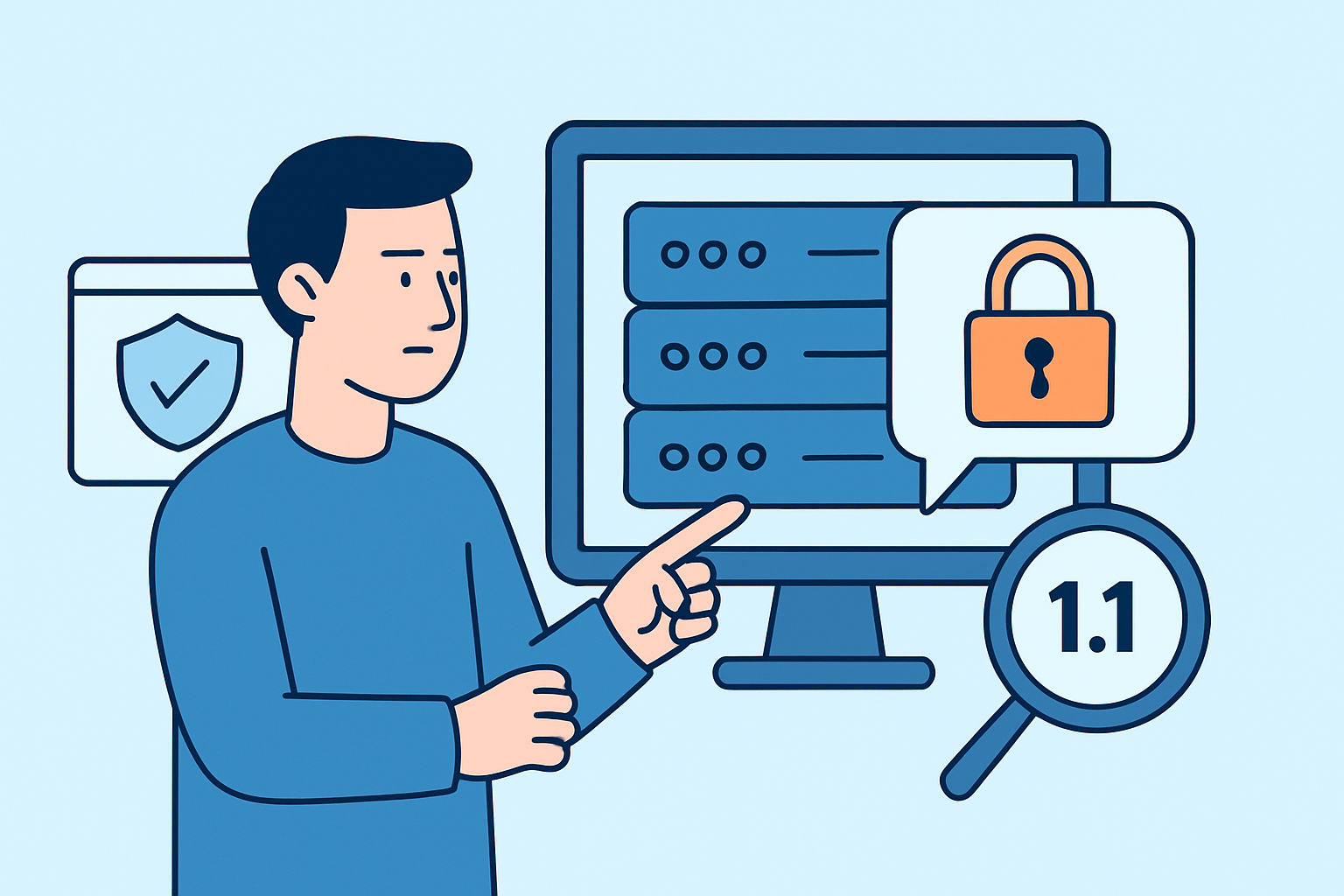
Server response headers give away far more than most teams realize – a raw Server: Apache/2.4.41 (Ubuntu) or X-Powered-By: PHP/7.4.3 string tells an attacker exactly which exploit database to search before they’ve sent a single malicious request. Server banner disclosure and version fingerprinting sit at the intersection of reconnaissance and exploitation, and understanding how they work is the fastest way to shrink the attack surface an outsider sees before they even try to break in.
What server banner disclosure actually reveals
A server banner is any string returned by your stack that identifies software and version. It shows up in HTTP headers (Server, X-Powered-By, X-AspNet-Version), in error pages that print stack traces, in SSH banners on port 22, in SMTP greeting strings, and in FTP welcome messages. Nginx defaults to sending Server: nginx/1.18.0. WordPress leaks its version number in the generator meta tag and in /readme.html. Apache’s default config appends the OS distribution to the banner, which is arguably worse than the version number itself because it narrows down available patches and default configs.
None of this is a vulnerability by itself. It’s reconnaissance data. But reconnaissance is step one of the Cyber Kill Chain, and skipping it costs attackers almost nothing when the target hands the information over voluntarily.
How fingerprinting goes beyond the obvious headers
Attackers stopped relying on the Server header alone years ago, mostly because experienced admins started stripping it. Passive fingerprinting tools like Wappalyzer and BuiltWith, and active tools like Nmap’s -sV flag or WhatWeb, infer software identity from behavioral fingerprints: the order of response headers, how the server handles malformed requests, TLS cipher suite ordering (JA3/JA3S hashing), default error page templates, and timing characteristics of specific endpoints.
This is the myth worth busting directly: hiding or blanking the Server header does not make a server anonymous. Nmap’s version detection engine ships with thousands of probe-response signatures and can often identify Apache vs nginx vs LiteSpeed just from how each handles a request with an invalid HTTP method or a missing Host header, regardless of what the banner string says. Removing the header raises the cost of fingerprinting slightly – it stops the laziest automated scanners – but a motivated attacker with Nmap or a custom probe script gets there anyway in a few extra seconds.
That doesn’t mean banner suppression is pointless. It’s a layer, not a solution. The value is in filtering out the bulk of opportunistic bots that scrape Shodan and Censys results looking for a specific version string tied to a known CVE, then mass-target every match. Shodan indexes over 300 million internet-facing devices with searchable banner data; a query like Apache/2.4.49 (the version with CVE-2021-41773, the path traversal flaw exploited within 48 hours of disclosure in October 2021) returns a target list instantly. Removing that exact string from your response headers takes you out of that specific query, even if a targeted attacker could still identify the software another way.
Real-world exploitation timeline
A typical pattern from the last few years looks like this. A CVE drops – say the Log4Shell vulnerability (CVE-2021-44228) disclosed on December 9, 2021. Within 24 hours, scanning traffic for vulnerable Log4j signatures spiked across the internet, according to data multiple security vendors published that week. Attackers weren’t manually testing each site; they were cross-referencing Shodan/Censys banner data against a list of known-vulnerable version strings and firing exploit payloads at every match. Sites that exposed clear version banners were triaged and hit first. Sites running the same vulnerable software but without an obvious banner sometimes got a few extra days before someone bothered probing them individually.
That delta – hours to days – is the entire value proposition of banner hardening. It’s not prevention. It’s buying time to patch before you’re on the first wave of an automated sweep.
Fixing banner disclosure across common stacks
The fixes are configuration changes, not code changes, which makes this one of the higher ROI items on a hardening checklist.
For nginx, set server_tokens off; in the http block to strip the version number, leaving just nginx in the header. For Apache, set ServerTokens Prod and ServerSignature Off in httpd.conf, which reduces the banner to Server: Apache with no version or OS. PHP applications should set expose_php = Off in php.ini to kill the X-Powered-By header. IIS admins typically need the URL Rewrite module or a tool like UrlScan to strip X-Powered-By and the X-AspNet-Version header, since IIS doesn’t expose a simple config flag for it. WordPress sites should remove the generator meta tag with a one-line filter (remove_action(‘wp_head’, ‘wp_generator’);) and block direct access to readme.html at the web server level.
Common mistakes teams make
A few patterns show up repeatedly during audits. Teams strip the Server header on the main site but forget it on a staging subdomain, an internal admin panel, or a load balancer health-check endpoint that’s still reachable from the public internet – attackers routinely pivot through the forgotten subdomain instead. Teams also treat banner suppression as a finished task rather than something to re-verify after every infrastructure change; a config management tool redeploying default nginx settings after a server rebuild silently reintroduces the version string. And some teams over-invest in banner hiding while leaving the actual vulnerable version unpatched underneath – the CVE is still exploitable via behavioral fingerprinting even if the string is gone, so suppression without patching is security theater.
A seasoned pentester’s first move against a new target is rarely a headline exploit. It’s a slow, unglamorous pass with Nmap, WhatWeb, and a Shodan lookup to build a software inventory. Denying that inventory-building step forces the attacker further down a more manual, more error-prone, and slower path – which is exactly where automated defenses and monitoring have the best chance of catching them before real damage happens. Running a broader check across headers, error pages, and exposed metadata as part of a routine website security checklist catches most of this in one pass, and cross-referencing exposed versions against OWASP Top 10 risk categories helps prioritize which disclosures actually matter versus which are cosmetic.
FAQ
Does hiding the Server header stop attackers from identifying my software?
No. It stops passive banner-grabbing tools and automated scanners that search Shodan/Censys for exact version strings, but active fingerprinting tools like Nmap’s version detection can often still identify the software family through behavioral probes. Treat it as a filter against opportunistic scanning, not as anonymity.
Which is more important: hiding the banner or patching the vulnerability?
Patching. Banner suppression only delays discovery; an unpatched vulnerability is still exploitable once an attacker identifies the software through other means. Fix the underlying version first, then suppress the banner as a secondary layer that buys extra time against the next disclosed CVE.
Do error pages leak version information too?
Yes, often more than headers do. Default error pages (a PHP fatal error, an ASP.NET yellow screen of death, a Django debug traceback) frequently print exact framework versions, file paths, and sometimes database connection details. Custom error pages should replace all default framework error handlers in production, not just the 404 page.
Banner and fingerprint exposure is a low-effort, high-value fix precisely because it’s a config change rather than a code rewrite – running it through a scan that checks headers, error handling, and exposed metadata together, such as what happens during an automated security scan, catches drift before an attacker’s reconnaissance pass does.