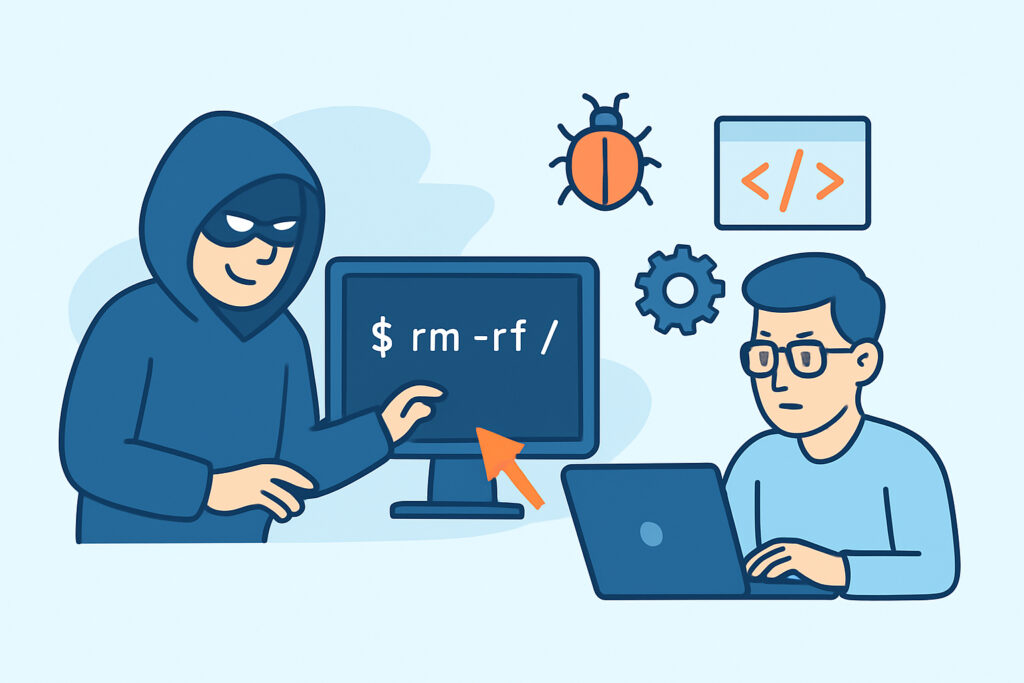
Command injection remains one of the most devastating vulnerability classes in web application security because it hands an attacker something they rarely get elsewhere: direct execution rights on the underlying operating system. Where SQL injection lets someone manipulate a database, command injection lets them run arbitrary shell commands on the server itself, which usually means full compromise rather than partial data exposure.
What Command Injection Actually Is
Command injection happens when an application passes user-supplied input into a system shell without properly sanitizing it. Many web apps still shell out to the operating system for convenience – resizing images with ImageMagick, pinging a host to check connectivity, converting files with a command-line tool, or generating PDFs. Each of those calls is an opportunity for disaster if the input isn’t handled correctly.
A classic example: a “network diagnostics” feature on an admin panel that lets a user enter a hostname to ping. The backend builds a string like ping -c 4 ” + userInput and passes it to a shell. If the input validation only checks for a valid-looking domain format but doesn’t block shell metacharacters, an attacker can submit something like example.com; cat /etc/passwd and the server will happily run both commands.
How Attackers Discover and Exploit These Flaws
Exploitation usually follows a predictable pattern:
They look for functionality that plausibly touches the OS – file conversion tools, backup utilities, network tests, image processors, log viewers, anything that feels like it might shell out.
They test with metacharacters. Semicolons, pipes, ampersands, backticks, and dollar-parentheses are the classic injection points on Linux systems (; | & ` $()), while Windows environments use & | && and command separators specific to cmd.exe or PowerShell.
They confirm the vulnerability with time-based or output-based techniques. A payload like ; sleep 10 that causes a measurable delay confirms blind command injection even when no output is returned to the page. If output does reflect back, something as simple as ; whoami proves execution instantly.
Once confirmed, escalation is fast. Attackers chase reverse shells, drop web shells for persistence, read environment variables and configuration files for credentials, and pivot into internal networks if the compromised server has access to other systems.
A real-world pattern worth knowing: many command injection incidents don’t come from obviously dangerous features. They come from “helper” scripts written quickly for internal use – a cron job trigger, a cache-clearing endpoint, a legacy PHP script calling exec() or shell_exec() that nobody has touched in years. These get forgotten precisely because they work fine until someone probes them deliberately.
Common Coding Mistakes That Cause It
Most command injection bugs trace back to a handful of recurring mistakes:
Concatenating user input directly into shell command strings instead of using parameterized execution functions.
Relying on blocklists for dangerous characters instead of allowlists. Blocklists are chronically incomplete – there’s almost always an encoding trick, a Unicode variant, or a less obvious metacharacter that slips through.
Trusting client-side validation. JavaScript form checks are cosmetic; server-side validation is the only validation that matters.
Using shell interpreters at all when a language’s native library function would do the same job safely. Many “convenience” shell calls exist purely because a developer didn’t know a native alternative existed.
Insufficient sandboxing of the process that executes the command, so even a successfully contained injection still lands in an environment with broad filesystem or network access.
How to Prevent Command Injection
Prevention comes down to a short list of disciplined practices:
Avoid shell execution entirely where possible. Use built-in language libraries for tasks like file manipulation, image processing, and network requests instead of shelling out to system binaries.
When shell execution is unavoidable, use APIs that pass arguments as an array rather than a concatenated string – this bypasses shell interpretation of metacharacters entirely. Most modern languages support this (subprocess with a list in Python, execFile in Node.js, ProcessBuilder in Java).
Apply strict allowlist validation on any input that does reach a command – restrict to expected characters, expected length, and expected format, and reject anything else outright.
Run processes with the least privilege necessary. If a compromised process can only read one specific directory, the blast radius of a successful injection shrinks dramatically.
Keep dependencies and command-line tools patched, since some command injection vulnerabilities originate not from application code but from flaws in the third-party binaries being invoked.
This is also where regular injection testing across multiple vulnerability classes earns its keep – command injection rarely travels alone, and an application vulnerable to one form of unsanitized input often has sibling issues elsewhere in the same codebase.
Busting the Myth: “It’s Only a Risk on Legacy Systems”
A persistent misconception is that command injection is a relic of old PHP applications and outdated system administration scripts. In reality, it shows up regularly in modern stacks too – Node.js apps calling child_process.exec(), containerized microservices that shell out for file conversion, and CI/CD pipeline tools that process untrusted branch names or commit messages. The underlying mistake – trusting input inside a shell context – doesn’t disappear just because the framework is newer. Modern tooling makes the safe APIs easier to use, but only if developers actually reach for them instead of the quick concatenation shortcut.
Command injection also frequently overlaps with other injection-style flaws such as server-side template injection, where unsanitized input reaches a template engine capable of executing code rather than a shell directly. Both share the same root cause: user-controlled data reaching an interpreter that was never meant to trust it.
Frequently Asked Questions
Can command injection be exploited without visible output on the page?
Yes. This is called blind command injection, and attackers confirm it using time delays (like a sleep command) or by triggering out-of-band requests to a server they control, since the response doesn’t need to reflect command output for the attack to succeed.
Is command injection covered under OWASP’s official risk categories?
It falls under the Injection category in the OWASP Top 10, alongside SQL injection and other input-handling flaws, since they all stem from unsanitized data reaching an interpreter.
Does a web application firewall fully prevent command injection?
A WAF can block many known payload patterns, but it isn’t a substitute for fixing the underlying code. Encoding tricks and novel metacharacter combinations can bypass signature-based filtering, so secure coding practices at the source remain essential.
Command injection is unforgiving precisely because the payoff for an attacker is so high – not stolen rows in a table, but a foothold on the server itself. Treating any code path that touches a shell as a high-risk surface, defaulting to native library functions over shell calls, and validating input with allowlists rather than blocklists closes off the vast majority of real-world exploitation attempts.